Ice breaker II

Ideas that will help launch your young people into relationships
Obviously, peer relationships are a key to youth work. But close relationships are easier to describe than experience. The first step is getting young people to open themselves to each other. That's where icebreakers come in. Icebreakers get young people talking by comfortably leading them through the awkward first few minutes of a relationship. music camn help people gel


The goal is to help young people feel comfortable with each other, so avoid doing anything that might make the young people in your group feel ill at ease. For example, you could ask young people to form groups of eight and then line up according to height. It sounds innocent enough, but how will the five-foot-ten-inch girl or the four-foot-eleven-inch boy feel about it?

Common Ground

Game Summary: Teams will race to create lists of things that all the team members have in common.

Game Supplies: You'll need paper and pencils.

Form equal-sized teams of three to six. Give each team a sheet of paper and a pencil. Tell teams their challenge is to list everything they can think of that all team members have in common. For example, team members might all attend the same school, prefer the same kind of music, or like the same brand of tennis shoes. The only rule is that they can't list similar body parts, such as "We all have two arms, a brain, and a nose."

Tell teams they have three minutes to create their lists, so they need to work quickly. (Groups of five or six may need more time, but don't allow more than four to five minutes.) To add to the urgency and excitement of the game, inform teams when there's one minute as well as 30 seconds remaining.

When time is up, find out which team has the longest list and ask team members to read the similarities they listed. Then ask teams who had similarities not already listed to share them. To conclude, have the entire group discuss the following questions. Ask:

• How easy was it to discover something in common with another team member? With every team member?

• What does this reveal about the extent to which we're alike? The ways in which we're all different?

• How can our similarities draw us closer together? How can our differences help us grow closer?

Variation Idea: Challenge teams to list things members don't have in common — things that make each person unique. For example, kids may have been born in different states, might go to different schools, or might like different music. You might also challenge your entire youth group to list as many things as it can that members all have in common.

Personal Parables

Game Summary: Kids will use objects found in the room or in their possession to tell stories about themselves.

Game Supplies: No supplies are required.

Ask kids to form groups of five or six based on whether they're "pack rats" or "throw-it-out types." Then tell group members to introduce themselves to each other (if needed) and tell one thing they own that they'd never throw out.

After several minutes of discussion, explain that Jesus taught profound spiritual truths by telling stories about everyday objects — by telling parables. For example, Jesus compared God's kingdom to a mustard seed to explain how something that begins small can grow to a great size.

Tell kids you'd like them to do the same thing by choosing and using objects from the room, their purses, or their pockets to each tell their group an important thing about themselves. For example, someone might choose a driver's licence and explain that she delivers pizzas. Someone else could use a library card to represent his desire to be a novelist. Encourage listeners to ask questions to learn as much about the speakers as they can.

After kids tell their parables, ask each person to tell the entire group about the person to his or her left by summarising that person's parable.

Variation Idea: Modify this activity to fit the topic of your lesson. For example, if the lesson is on family relationships, have kids use objects to tell about their families. If the lesson is on music, have kids use objects to represent their favorite songs or performers.

sent in by Donna

Who Am I?


On slips of paper, or 3x5 cards write the name of some famous person, or character.
Tape the name on each group member's back (make sure they don't see the name).
When everyone has a name taped on their back, instruct them to discover what name is written on their back by asking others yes or no questions about the person.
For example: Am I a real person? Am I an adult? Am I male? Was I born in the United Kingdom? By narrowing the answers down, they may discover "who they are" and if they are correct, you may choose to give them a token prize.

Me Am What Me Am!

Give everyone in the group one paper clip, before the meeting begins. Preferably, before structured activities begin, instruct them that for the duration of the meeting, if they use the word "I" their clip will be taken from them. If they hear someone say the word "I" they may take the paperclip and attach it to their own. Throughout the evening, kids (and adults) will catch others using the word "I" and may add more clips to their own. Even if they have a nice chain of clips, they could lose them all, if they are caught using the word "I". A special prize can be given to the person who has the longest chain by the end of the meeting.
This is not only a great icebreaker, but a way to communicate to the group how we often use the word "I" in our conversations. We often put ourselves ahead of others, or even Jesus Christ himself!

sent in by, Ed

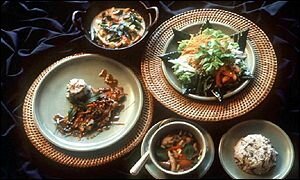
Try some ideas around the theme of food. Let us know what you have done.

try it with food


ARGUMENT ICEBREAKER

For this icebreaker, you will need to break your teens into groups of no more than seven, but no less than four.
BEFORE the teen meeting, and IN SECRET, recruit one teen for each group that will be the one who will disagree. That teen is instructed that NO MATTER WHAT, he is to do his best to make sure that the group does not reach a unified conclusion.

As the teens gather into the room, form them into groups (with one "disruptive" teen planted in each group) and tell them that you will be teaching on unity this evening. The first group to come up with an agreed-upon decision will each win a prize. Tell them the subject of discussion is two-minutes long, and the discussion is to be about uniforms on kids in public school. Start your stopwatch for two minutes.

This is WHAT WILL HAPPEN: While the team tries to arrive at a unified decision, your "planted" teen will do everything to disrupt by changing his mind. Even if the group agrees with his disagreement, he is to change his mind. You will see that discussion groups will get hostile toward the teen and even personal.

After the two minutes, blow the whistle and tell the whole youth group the scheme. Many of your teens will be embarrassed as they realise they got too personal when they should have been objective. Ask each of the "spy" teens how they were treated when they disagreed, and how the rest of the team felt about it.

MONEY ICEBREAKER

This is an especially good icebreaker before you start a Bible study on stewardship and the use of money.

Divide the group into teams of three and give each team a piece of paper and pencil. Mention a local shopping centre and tell the teens you are going to play a simulation game. Each team gets to go shopping but can only 'buy' one item at each shop. You might want to give them a list of the shops, but don't give them prices - let them guess what some things would be.

The idea is to see who can 'spend' the most money. Each team is to write down the item that they would buy at each store, and the teams have ten minutes to do so. After the time limit, allow each team to stand and tell what they 'bought' along with the prices. Sometimes you will get hoots and hollers when the other teens realise that the team was way off on the price of an object. This is a fun, low-stress opener that lets teens be aware of money concerns.

OPINION POLL ICEBREAKER

As you open this Sunday's meeting , you can get your kids to share their opinions. Hand out photocopied papers that have questions that will evoke strong opinions, but rather than having essay answers, use boxes that say "Strongly Agree" "Agree" "Don't know or Don't Care" "Disagree" and "Strongly Disagree." You should have three or four adults who can quickly gather the polls and tabulate the answers into one sheet for you. By the time you finish your opening songs, the adults should have the sheets' final tallies so that you can read them aloud. Some of your questions could include:

* I believe that we should go to war to punish those responsible for terrorism.
* i believe we should find a peacefull solution to conflict
* If we went into conflict I would find a way to serve in my community to help the cause.
* If we went into conflict I would find a way to serve in my community to oppose the conflict.
* I believe that God is doing this to teach us a lesson.
* I believe that God is in control of all of this.
* Since this has happened, I have had a closer walk with the Lord.


Spend the first few minutes of the meeting discussing the results. Your Bible study can grow from this opening.


Submit your ideas and any other material for the website to

http://www.youthworker.org


YWR 2004 ©
Site Design youthworker.org
youthworker.org.Web Design